For those living amidst breathtaking mountain vistas, the simple act of boiling an egg can sometimes feel like a culinary mystery. The perfect soft-boiled or hard-boiled egg you master at sea level often turns out undercooked or inconsistent at higher elevations. This isn’t a flaw in your technique, but rather a scientific phenomenon that impacts how water cooks food. Fortunately, with a few clever adjustments to your trusty egg cooker, you can consistently achieve flawless eggs, no matter how high you are.
Understanding High Altitude Cooking: The Science Behind the Scramble
|
Our Picks for the Best Egg cooker in 2026
As an Amazon Associate I earn from qualifying purchases.
|
||
| Num | Product | Action |
|---|---|---|
| 1 | Dash Rapid Egg Cooker - Boiler, Poacher & Steamer - Includes Measuring & Recipe Guide - Dishwasher Safe - Holds 7 Eggs, Aqua |

|
| 2 | Rapid Egg Cooker, 12 Egg Capacity Electric Egg Cooker for Hard Boiled Eggs, Soft, Medium, Poached Eggs, Food & Vegetable Steamer for Breakfast, One-Touch Button, Over-Heat Protect, BPA-Free |
|
| 3 | Mojoco Rapid Egg Cooker - Mini Egg Cooker for Steamed, Hard Boiled, Soft Boiled Eggs and Onsen Tamago - Electric Egg Boiler for Home Kitchen, Dorm Use - Smart Egg Maker with Auto Shut OFF and Alarm |
|
| 4 | Elite Gourmet EGC115B Easy Egg Cooker Electric 7-Egg Capacity, Soft, Medium, Hard-Boiled Egg Cooker with Auto Shut-Off, Measuring Cup Included, BPA Free, Classic Black |
|
| 5 | Elite Gourmet EGC-007## Rapid Egg Cooker, 7 Easy-To-Peel, Hard, Medium, Soft Boiled Eggs, Poacher, Omelet Maker, Auto Shut-Off, Alarm, 16-Recipe Booklet, White |
|
| 6 | DASH Electric Rapid Egg Cooker for Hard Boiled/Poached/Scrambled Eggs or Omelets with Auto Shut-Off Feature, Black, 7 Egg Capacity |
|
| 7 | DASH Rapid Egg Cooker: 7 Egg Capacity Electric Egg Cooker for Hard Boiled Eggs, Poached Eggs, Scrambled Eggs, or Omelets. |
|
| 8 | Elite Gourmet EGC322CBL Easy Egg Cooker Electric 7-Egg Capacity, Soft, Medium, Hard-Boiled Egg Cooker with Auto Shut-Off, Measuring Cup Included, BPA Free, Classic Blue |
|
| 9 | Elite Gourmet EGC115M Easy Egg Cooker Electric 7-Egg Capacity, Soft, Medium, Hard-Boiled Egg Cooker with Auto Shut-Off, Measuring Cup Included, BPA Free, Retro Mint |
|
| 10 | Evoloop Rapid Egg Cooker Electric 6 Eggs Capacity, Soft, Medium, Hard Boiled, Poacher, Omelet Maker Egg Poacher With Auto Shut-Off, BPA Free |
|
The fundamental reason cooking changes at high altitudes lies with atmospheric pressure. As you ascend, the air pressure decreases. This lower pressure has a direct and significant effect on the boiling point of water. At sea level, water boils vigorously at 212°F (100°C). However, for every 500-foot increase in elevation, the boiling point drops by approximately 1°F (0.6°C). For instance, at 5,000 feet, water boils around 203°F (95°C), and at 10,000 feet, it dips to approximately 194°F (90°C).
This might seem like a small difference, but it’s crucial for cooking. Since the water boils at a lower temperature, the heat transferred to your eggs is less intense. This means that proteins in the egg white and yolk take longer to coagulate and solidify. Simply put, while the water may appear to be boiling just as vigorously, it’s not as hot, and therefore, your eggs will require more time to cook through to the desired consistency. Traditional cooking times, designed for sea-level boiling points, simply won’t yield the same results in the mountains.
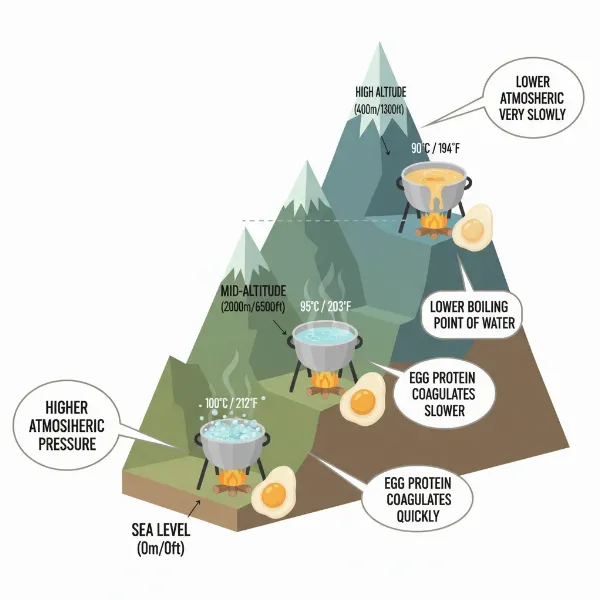 Diagram showing water boiling at lower temperatures and atmospheric pressure at high altitude.
Why Your Egg Cooker Needs Altitude Adjustments
Egg cookers operate by steaming eggs. A measured amount of water is heated until it boils, creating steam that circulates around the eggs to cook them gently and evenly. The cooker typically has a precise water measuring cup for soft, medium, or hard-boiled eggs, dictating the duration of the steaming cycle before the water fully evaporates.
At high altitudes, the lower boiling point means the steam generated is less hot than at sea level. If you use the standard water measurements provided with your egg cooker, the steaming process will still stop once that predetermined amount of water evaporates. However, because the steam is cooler, the eggs will not have received enough heat to cook properly within that shorter, less effective cycle. This often leads to frustratingly undercooked yolks or whites that are still runny when they should be firm. Your egg cooker isn’t broken; it just needs a little high-altitude love.
Adjusting Water for Your Egg Cooker: The Key to Perfection
The primary adjustment you need to make for your egg cooker at high altitudes is to increase the amount of water you use. Since the eggs need a longer time exposed to the steam to cook thoroughly at the lower temperature, adding more water will extend the steaming cycle. The cooker will continue to generate steam until all the water has evaporated, so a larger volume of water translates directly to more cooking time.
While specific, universally perfect measurements can be tricky due to variations in altitude and egg cooker models, here’s a general approach:
- Start with Incremental Increases: As a rule of thumb, consider adding an extra 10-20% more water than the manufacturer’s recommendation for your desired egg consistency. For example, if your cooker suggests 50ml for hard-boiled eggs at sea level, try 55-60ml at elevations around 5,000 feet.
- Altitude Bands:
- 3,000 – 5,000 feet: Add approximately 10-15% more water.
- 5,001 – 7,000 feet: Increase water by about 15-25%.
- Above 7,000 feet: You might need to increase water by 25-40% or even more, depending on your specific altitude and desired doneness.
- The Trial and Error Method: This is your best friend. Start with a small increase in water and cook one or two eggs. Assess their doneness. If they are still too soft, add a little more water next time. If they are overcooked, reduce the water slightly. Keep a log of your successful water amounts for different consistencies and altitudes.
Remember, the goal is not to make the water hotter (which isn’t possible in an open system like an egg cooker at high altitude), but to prolong the exposure time to the available steam temperature.
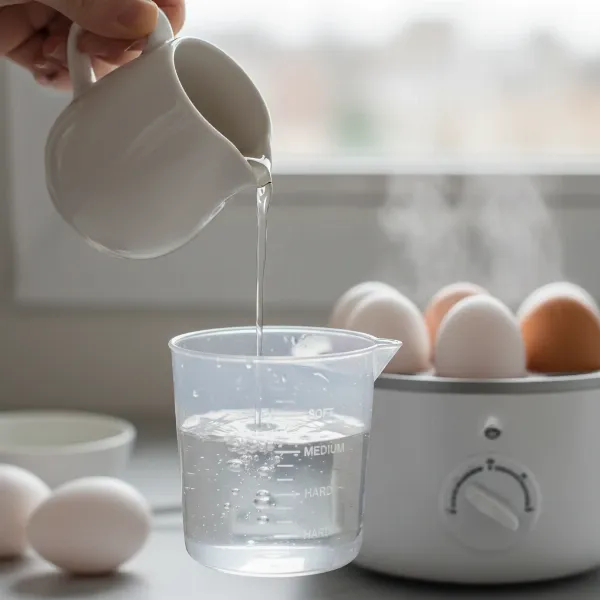 Hand adding extra water to an egg cooker measuring cup for high altitude cooking.
High Altitude Egg Cooker Settings and Timing Chart
While your egg cooker’s measuring cup provides guidelines, you’ll effectively be creating your own high-altitude chart. The “timing” is directly controlled by the amount of water. Below is a general guide to help you estimate adjustments. These are starting points and will require personal calibration.
| Desired Doneness | Sea Level (Standard Water) | 3,000 – 5,000 ft (Est. +10-15% Water) | 5,001 – 7,000 ft (Est. +15-25% Water) | Above 7,000 ft (Est. +25-40%+ Water) |
|---|---|---|---|---|
| Soft-Boiled | 7-8 minutes | 8-10 minutes | 9-11 minutes | 10-13 minutes |
| Medium-Boiled | 9-10 minutes | 10-12 minutes | 11-13 minutes | 12-15 minutes |
| Hard-Boiled | 12-14 minutes | 14-17 minutes | 16-19 minutes | 18-22+ minutes |
Note: The “minutes” here represent the effective steaming time determined by the water quantity. You are adjusting the water to achieve these longer steaming durations.
Beyond Water: Essential Tips for High Altitude Egg Cooking Success
While water adjustment is paramount, a few other expert tips can further enhance your high-altitude egg cooking experience:
- Bring Eggs to Room Temperature: Cold eggs directly from the refrigerator are more prone to cracking when introduced to heat. Allowing them to sit at room temperature for 10-15 minutes can help prevent this and ensure more even cooking.
- Use Slightly Older Eggs: Eggs that are 1-2 weeks old tend to peel much more easily than very fresh eggs. This is due to a slight change in pH as eggs age, making the membrane less adhesive to the shell.
- The Ice Bath is Your Friend: Immediately after your egg cooker finishes its cycle, transfer the cooked eggs to a bowl of ice water. This “shocking” process rapidly halts the cooking, preventing the dreaded greenish-gray ring around the yolk often seen in overcooked eggs. It also significantly aids in easier peeling.
- Consistency is Key: Once you find the perfect water amount for your altitude and desired doneness, stick to it. Use the same type and size of eggs, and consistently measure your water for reproducible results.
Troubleshooting Common High Altitude Egg Cooker Issues
Even with adjustments, you might encounter some common challenges. Here’s how to troubleshoot them:
- Eggs Still Runny/Undercooked: This is the most common issue. You need more cooking time. Next time, add a greater quantity of water to your egg cooker. Increase in small increments until you reach your desired consistency.
- Cracked Shells: This can be due to rapid temperature changes. Ensure your eggs are at room temperature before placing them in the cooker. Avoid overcrowding the egg tray, which can cause uneven heat distribution or physical damage.
- Greenish-Gray Yolk: This indicates overcooking. The iron in the yolk reacts with hydrogen sulfide from the white, a harmless but aesthetically unappealing reaction. Reduce the amount of water slightly in your next batch, or ensure you use an ice bath immediately after cooking to stop the process.
Choosing the Right Egg Cooker for High Altitude Living
When selecting an egg cooker, especially for high-altitude use, consider these features:
- Precise Water Measurement: While you’ll be adjusting, a cooker with clear, marked measurements (even if you’re deviating from them) provides a good baseline.
- Adjustable Settings: Some advanced models might offer settings for different cooking styles or even have altitude-specific modes, though these are rare. Look for models that give you control over the steaming duration.
- Durability and Reliability: A consistent heating element is vital when precise timing and temperature (relative to boiling point) are crucial.
For those who frequently cook at very high altitudes or need absolute precision, a pressure cooker can also be an excellent alternative for eggs. Pressure cookers raise the internal boiling point of water, mitigating the effects of high altitude and allowing for more conventional cooking times.
Conclusion
Conquering high-altitude egg cooking with your egg cooker is entirely achievable. By understanding the science behind the lower boiling point and making simple adjustments to the water volume, you can reliably produce perfect eggs every time. Remember that patience and a willingness to experiment are your greatest tools. So, don’t let the elevation deter you from enjoying perfectly cooked eggs. With these insights, you’re ready to master your egg cooker, from sea level to the highest peaks.
What’s your secret to perfect high-altitude eggs?